How an Instagram Post Became a Blueprint for Murder: An OSINT Case Study
Pop Smoke | Real-World OSINT Case Study
- Categories
- OSINT · OPSEC
- Published
- Oct 16, 2025

In the first part of this series, we explored the manual side of OSINT: the patience, instincts, and critical thinking that shape an investigator's craft. In the second, we looked at automation, the tools and workflows that scale those skills without replacing them. Now, it's time to see how these ideas play out in the real world.
In the age of social media, the line between private and public is vanishing. For most, this means risking a little privacy for a few likes. But for rapper Pop Smoke, it was an operational security (OPSEC) failure that ultimately led to his murder in a Hollywood Hills rental home in February 2020.
This case is a real-world lesson in how Open-Source Intelligence (OSINT), the art of gathering and analyzing publicly available information, can be weaponized by criminals, often with devastating consequences.
The OSINT Methodology: How Criminals Targeted Pop Smoke
The perpetrators in this case were not sophisticated cybercriminals. They were opportunistic teenagers who used basic OSINT techniques to identify, track, and locate their target, driven by the promise of a quick and lucrative robbery.
Their process likely followed a simple, repeatable framework:
1. Objective: Identify a high-value target
The attackers, who were gang members, were likely monitoring social media for celebrities or public figures who displayed wealth. Pop Smoke, known for his flashy lifestyle and recent rise in fame, was a prime candidate. His growing visibility in Los Angeles made him easy to spot, and even easier to track online.
2. Data collection: Gathering public information
The gang members used public social media accounts as their primary intelligence source.
- Wealth signals: Posts from the weeks leading up to the murder featured Pop Smoke holding large stacks of cash and wearing expensive jewelry, including a diamond-studded Rolex. This confirmed a profitable motive for a robbery.

- Location leak: Just hours before the home invasion, Pop Smoke made a critical error. He posted a video on social media featuring gift bags with the full address of his rental home in the Hollywood Hills clearly visible on the tag.
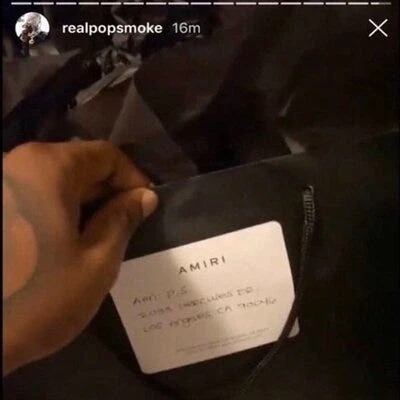
- Geospatial analysis: The gift bag photo and security camera footage of cars surveilling the neighborhood allowed the attackers to confirm the exact location and plan their approach.
3. Data analysis: Correlating the intelligence
The attackers pieced together the information they had gathered. By cross-referencing Pop Smoke's recent Instagram stories, past posts, and geotagged photos, they confirmed that the address on the gift bag matched a Hollywood Hills neighborhood consistent with his usual lifestyle. They also noticed clues such as the type of house, the visible driveway, and luxury cars seen in other posts. These correlations gave them a **high-confidence location profile,**enough to plan a physical approach with minimal uncertainty.
4. Execution: The criminal act
Armed with this intelligence, the attackers organized a late-night robbery attempt. Security camera footage later showed two vehicles slowly circling the home before stopping nearby. Around 4:00 a.m., four intruders entered through a second-story balcony door. Inside, they confronted Pop Smoke and his associates, leading to a brief struggle and ultimately his fatal shooting. Their ability to locate and strike the target was a direct consequence of publicly available data being analyzed and acted upon.
Pop Smoke's Critical OPSEC Failures
Bashar Jackson's tragic death was the outcome of simple but profound OPSEC failures. His mistakes are a cautionary tale for anyone with a public online presence.
- Failure to protect location data: The most severe and easily avoidable error was the public posting of his address. This is a primary OPSEC rule: never publish sensitive location information.
- Flaunting wealth on a public profile: The constant display of expensive possessions acted as a "loud" signal to potential criminals.
- Underestimating the threat: As a public figure, Pop Smoke was a target. His failure to recognize this and implement basic digital security measures showed a lack of threat awareness.
- Not using private settings: By keeping his Instagram public, he gave a massive, unfiltered audience access to his movements and assets - the digital equivalent of leaving the front door open.
Lessons From the Tragedy
The Pop Smoke case serves as a grim reminder that the information we share online has tangible, real-world consequences.
For individuals and security professionals alike, the key lessons are:
- Every post is intelligence: Assume every image, video, and caption can be analyzed by someone with malicious intent.
- The threat is not always "sophisticated": Some of the most dangerous intelligence is gathered through the simplest means.
- Think like a threat actor: Before posting, ask yourself what a bad actor could extract. Does it reveal your routine, your location, or your possessions?
- OPSEC is personal security: Protecting location data, managing privacy settings, and practicing digital hygiene are no longer optional. They are fundamental to personal safety.
Pop Smoke's murder is a tragic testament to the fact that in our hyper-connected world, the biggest security risk is often the one staring back at us from our own social media feeds.
Thanks for reading. — Steve